Monday, June 08, 2009


Monday, May 18, 2009


Jacob's Ladder have been blooming for a few days now; Columbine and Mohican Viburnum just burst over the weekend.

Pond Stage 4

A Little Detail
Pond Garden Stage 4 is a go; so far I've covered about 28 square feet of overlayment covered in poultry wire (for reinforcement) and coated it with a mixture of cement, peat moss, the occasional rock or stone, and various decorations including sea shells and chunks of marble tile.
First ruby-throated Hummingbird of the year spotted buzzing about the Columbine. Add to that the first Baltimore Oriole seen in the Maple trees. Peepers not quite as prevalent as they were a few weeks back, but it may be due to the cold stint we've been having (frost in some areas last night). A male Eastern Bluebird has been hanging around the houses, but no nest yet. Red-shouldered hawk has been quite vocal for the last week.
Natives in Bloom:
- Canada Anemone
- Columbine
- Jacob's Ladder
- Rue Anemone
- Purple Pasque Flower
Wildlife Spotted:
- Baltimore Oriole
- Black-capped Chickadee
- Blue Jay
- Chipmunk, Eastern
- Chorus Frog
- Cottontail Rabbit
- Eastern Bluebird
- Goldfinch
- Grey Squirrel
- Loon
- Nuthatch
- Pileated Woodpecker
- Red-shouldered Hawk
- Red-winged Blackbird
- Ruby-throated Hummingbird
- Squirrel, Gray
- Turkey Vulture
Sunday, May 10, 2009

White Oak Flower
While these may not be the more "traditional" blooms of the cherry or lilac most people are familiar with, they are flowers. The little bumps on the catkin above are actually the male portion of the flowers. When the male portion spreads its pollen, it is shed by the tree; you'll often see loads of male catkins on the ground in late Spring.

Pond, Stage 3

The bog portion of the pond
The pond is now at stage 3... the underlayment is complete, the main tarp has been laid down, and several overlapping layers of old liner have been added on top of it as overlayment. Have secured it to the sides mostly by way of bricks or stakes for nwo. We've added plant shelves, and have roughed in the bog section. The deepest section is around 3'6, not counting the 3 inches of dirt I have added for burrowing amphibians and reptiles.
It's been good weather for pond work; holding in the 50's in the afternoon. Quite cool for mid-Spring.
Wednesday, May 06, 2009

Cherry trees (seen here in this morning's mist) are currently exploding with white blossoms. Clusters of Columbine leaves are coming up in droves (no flowers yet), and we're just starting to get buds on our Prairie Smoke.
Temps have been cool; 40's in the morning pitching into the 70's in the late afternoon, with a good amount of stormclouds and light rain. Fewer birds than usual at the feeder, though they're all extremely noisy in the morning. Have heard a few Tree Frogs announcing themselves amongst the chorus of Peepers and Chorus Frogs which, since the rains, have extended from morning to late night.

Pond Rework, Stage 2 (now an unholy mess)
Pond is fully flushed out now, except for one plant shelf. Have started filling the finished parts with underlay; the stuff that keeps any rocks, roots, or burrowing creatures from puncturing the liner. Have used everything from plastic landscaping bags to carpet to bits of the old pond tarp and even car mats and used (clean) towels and rags for that purpose. Looks like an unholy mess, but it's the second R of reduce, reuse and recycle, and better serving a purpose under my pond than taking up space in a landfill somewhere! Will use a good amount of the old pond tarp as an overlayment; especially on the plant shelves (which you'll notice are given ample space below the rim of the pond, and in the bog section.
Monday, August 27, 2007

- Columbine
- Elm-leafed Goldenrod
- Harebell
- Woodland Sunflower
Monday, July 02, 2007

A diagram showing how we plan to eventually rig the wiring of the pond. One pump (the one currently aerating and filtering) will be left to run on the current circuit, while another circuit will be added to run:
- Outlets on the deck
- The main garden lights
- The lotus spitter pump (on a timer)
- The accents (submersible lights and foggers) (on a timer)
- The waterfall pump (on a dim switch)
Wednesday, June 27, 2007

Tuesday, June 19, 2007

Added 40 granite cobbles to the edge of the pond over the weekend. Purchased them for around $1.49/ea from Menards. The goal here isn't to cover the entire surface of the tarp; just that which is above the water line. Granite gives it a nice, natural look, and provides less surface area for evaporation and algae growth than sand, dirt, or river rock (algae has not been a problem yet this year; not sure if that can be chalked up to the fish, the snails, the added plants, the excavating we did in the stream, or sheer luck).
The stones also provide a hiding and hibernation spot for frogs and other amphibians, most notably the Spring Peeper, who will overwinter above ground, basically freezing in place between stones or rocks or in logs, only to return to life the following spring.
Sunday, June 17, 2007


We thought we'd consider everything when we installed the new waterfall; lining it with two layers of rubber; reinforcing the concrete with poultry wire and sealing it with the same stuff they use on birthbaths. The only thing we failed to consider was the path it would take around the paver block at the output.
I didn't discover this, of course until after a little over eight hours of steady operation. By this time, the water level had dropped just enough to be perceptible. Checking around the waterfall, I found a damp spot in the soil behind the waterfall where a jet of water, fanning around the rock at the output, had run over one of the rocks at the rim, spilling a little over a gallon an hour.
I bought some special waterproofed cement from the hardware store and originally tried to patch around the edges of the paver, but that only caused the water to jet, with extra force, causing a lot of it to splash over the edge, losing water ev en more rapidly. Finally settled on removing the patch, and cementing in some more stones along the edge.
We're still losing some water, probably around a cup an hour due to splattering, but I plan to fix this by adding a dimmer to the outlet controlling the pump. Less water, less splatter, more efficiency.


Wildlife Spotted this Week:
- Baltimore Oriole
- Black-capped Chickadee
- Blue Jay
- Cedar Waxwing
- Cottontail Rabbit
- Eastern Bluebird
- Eastern Chipmunk
- Goldfinch
- Green Frog
- Grey Catbird
- Grey Squirrel
- Lightning Bug
- Monarch Butterfly
- Mourning Dove
- Northern Cardinal
- Nuthatch
- Red-bellied Woodpecker
- Robin
- Swamp Sparrow
Native Plants in Bloom this Week:
- Blue flag Iris
- Canadian Anemone
- Daisy Fleabane
- Harebell
- Spiderwort
- Swamp Buttercup
- Swamp Milkweed
Monday, June 04, 2007


Birds spotted:
- Baltimore Oriole
- Black-capped Chickadee
- Blue Jay
- Crow
- Eastern Bluebird (three chicks counted)
- Grackle
- Mourning dove
- Nuthatch
- Oriole
- Red-headed Woodpecker
- Ruby-throated Hummingbird
Other Wildlife Spotted:
- American Toad
- Chipmunk
- Green Frog
- Grey Squirrel
- Raccoon
Natives in bloom:
- Canadian Anemone
- Columbine
- False Indigo
- Harebell
- Prairie Ninebark
- Rue Anemone
- Swamp Buttercup
Non-natives in Bloom:
- Fuschia
- Tuberous Begonia
Things I should have considered when I originally built the pond:
- How to do it all with one piece of tarp
- Where all pumps, accessories, power cords, and hoses would go, and how they would be rigged and concealed.
- How I planned to hide the pond tarp (on the rebuild, I excavated a submerged shelf for boulders).
- How to better integrate it with the patio/deck/surrounding landscape
- The specific needs of wildlife that might be interested in it (frogs that require oxygen-rich water for hibernation)
- Learned more about fish. Turns out that, given the correct circumstances, you can add a number of fish to your pond, including minnows, guppies, and swordtails.
Thursday, May 17, 2007
 About a year ago, we tried to merge our first plastic basin pond with a rubber liner pond I'd just put in. To this effect, I dug a trench for a stream, cut a channel in the plastic with my jigsaw, and bolted and caulked the two together.
The thing leaked like a sieve, and no amount of caulk, expanding foam, or overlapping liner would stop it. Figuring it had something to do with the expansion and contraction of the plastic pond under the heat of the sun, I ripped out the plastic pond, and replaced it with a rubber liner, and sealed it with some industrial glue and caulk. While there was less leaking, I was still losing over two inches a day, which over an 18'X5' pond is a pretty major deal.
This spring, we used a putty knife to strip the glue and caulk, and used seam tape as recommended, and when that failed, put a lining of reinforced cement underneath and over the liner (trimming the liner so that the cement bonded in the middle). This cement sandwich was treated with a birdbath-type finish we got at a statue shop up in Nisswa.
 When this failed, Amanda suggested we just buy one large liner for both ponds. Which is probably what we should have done in the first place. On the upside, barring holes or tears, this almost gauruntees no leaks, and allowed me to do a bit more landscaping, adjusting the grade of the soil so that the liner will be easier to hide under boulders, and digging a much deeper stream. On the downside, it meant removing the 500 lbs of cement we'd spent a weekend pouring into the stream. This was achieved over two days with a shovel, a 20 lb sledge, and a 60 year old pry bar.
In all, this gained us around four inches of stream, to which I added another 6-7 inches, not only to give the fish more breathing room when swimming it and keep the water a bit cooler (preventing algae and evaporation) but also to even out the depth between the ponds, giving me a bit more leeway with the new liner.
 So, on the downside, the pond is gong to need a major overhaul. On the upside, we've added a basin fountain/planter and another waterfall, this one built from a layer concrete reinforced with chicken wire we poured on top of a liner. We lined it with rocks from the property in Stillwater, and a pile of granite cobbles we picked up on sale at Menards, filling the rest out by shaping the drying cement to look like stones. We then sealed it with two layers birdbath sealer, and it appears to be holding quite well. The basin fountain was much simpler. Just a hole covered with two layers of liner and more cobblers strategically positioned to hold dirt. Bought a fountain with a 3/4" lotus-shaped sprinkler head, then used a diverter with a valve that spurts into the basin (built some rocks up around it to make a pleasant splashing noise), since most of the water's being shot through the valve, the remaining water sporadically "leaps" from the sprinkler head in a really interesting way.
So, as a weekly to-do list, I still have to do the following to get the yard in shape (in no particular order):
- Add the new liner (this week)
- Add submersible accent lights to the pond
- Add a motion-sensitive light to the deck
- Add accent lights to the deck
- Landscape the front yard (6x6's and a short split-rail fence along the corner)
- Finish the boardwalk around the backside of the pond
- Add latticework along the boardwalk
- Add lights to the boardwalk
- Hook the lights and pumps up to switches and timers
- Put latticework along the deck
- Get the remaining chunks of the plastic basin pond basin out to the garbage
- Mount the remaining peanut feeder
- Mount the bat house


Friday, October 06, 2006

Wednesday, October 04, 2006
Monday, October 02, 2006
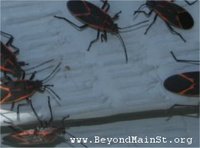 I just read a passage in Weird Minnesota (Mark Moran et all) about a plague of locusts averted when a strong frost wiped out the eggs. It got me wondering if the rising temperatures over the weekend were the spark in the boxelder bug powder keg that's left many Twin Cities houses and business fronts coated in a teeming skin of the small black and red-striped beetles. Fortunately, unlike locusts, these native insects are unlikely to wipe out our crops or cause blood poisoning in livestock. The only real damage involved is the nuisance of cleaning up the thousands of brittle insects carcasses.
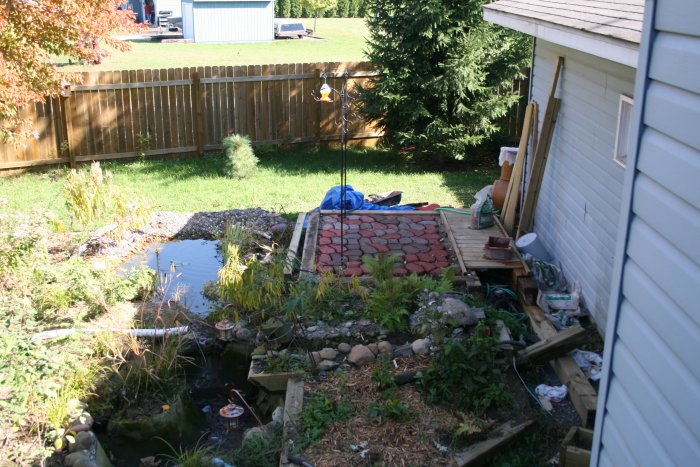 Finally polished off the patio blocks. Had to add a bit of color to the first set I poured out over three weeks ago, as the rain was already fading the red and turning the surface fo the brown stones to salt-and-pepper. Also added a coat of sealer to cure and weatherproof. Hope to get the sand packed in by Wednesday.
The other weekend big project, replacing the West pond basin, is at least half finished in that the pond has been drained, the plants, frogs and fish fry relocated to the East Basin, and holes punched in the bottom. Over the week I'm planning to take out some righteous IT-related rage ("you did WHAT to your work computer?") on the unsuspecting rigid liner with an axe and sledge hammer. But not tonight. Tonight's' my anniversary, which I PROBABLY would have remembered on my own, even if my beautiful Irish wife hadn't taken it upon herself to casually remind me for the last month and a half.
Her: Isn't it amazing we'll have been married for two years?
Me: It sure is.
Her: Two years as of five weeks and three days.
Me: Wow, I didn't know you had it down that far.
Her: Has it felt like two years?
Me: It sure has.
Her:
Me: Uh, I mean, NO, it hasn't.
Her:
Me: I mean --
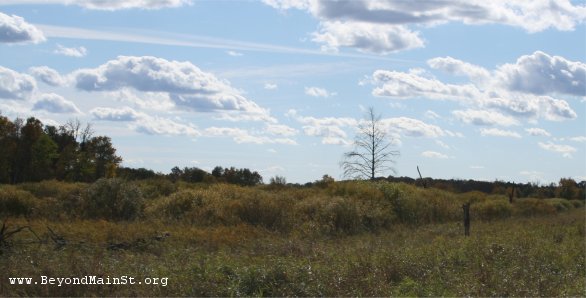
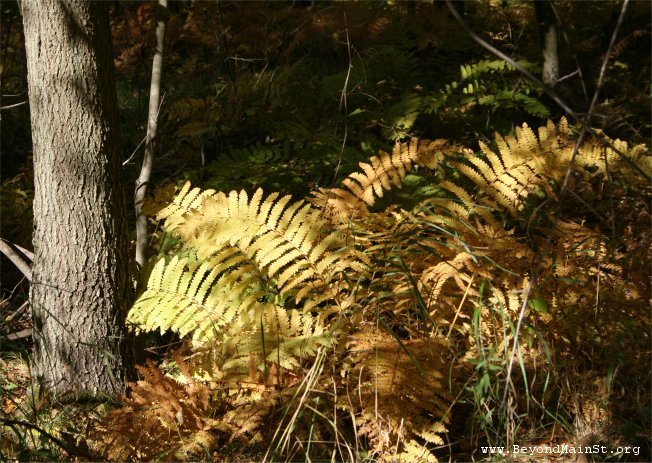
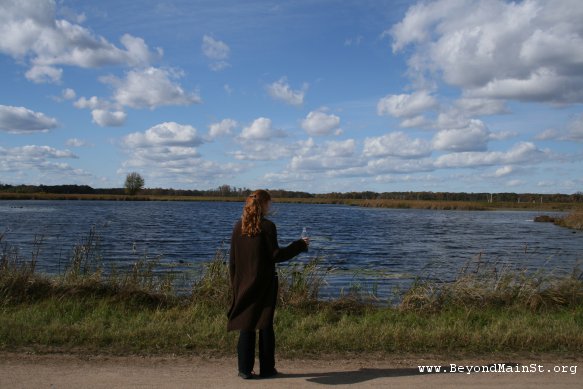
At any rate, here's some fall color from our jaunt out to the Forest Lake/Wyoming side of the Carlos Avery WMA.
Click the thumbnails to see larger versions.



Sunday, September 24, 2006
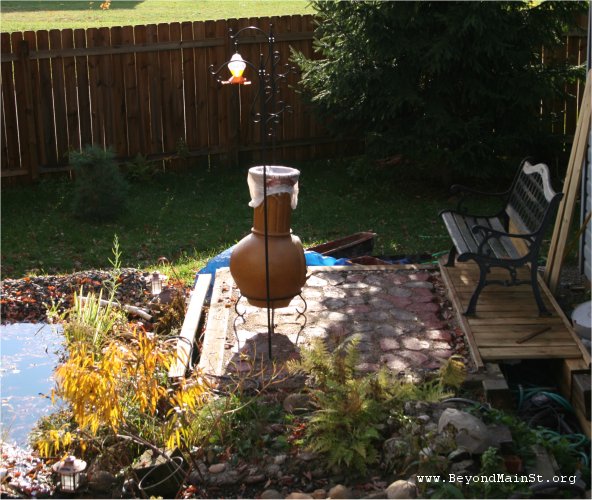
 After what felt like a week of rain, clouds, and cold, Apollo's chariot made its appearance bright and early this morning. I couldn't have asked for a nicer day to end the weekend; clear skies, and temperatures hovering in the upper 60's! Took advantage of it to re-screed and lay as many bricks as our stash of concrete would allow.
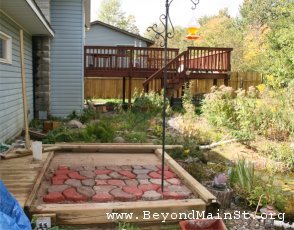 I think I'm finally hitting my patio-laying stride, which is rather sad as I only have about 3 feet to go. Instead of just randomly placing the blocks I've worked them into what I think of as a 'Lake Superior' pattern, with brown as the lake and streams and red as the mainland and islands.
Found each form takes about 1 1/4 60 lb. bags of concrete, and about 1 can of color. Since I'm doing approximately half red and half brown, that means mixing the cement, color, and water in separate tubs, then transporting them from the tubs to the work site in small containers. Care has to be taken to pour the cement carefully (the colors look shoddy when mixed), and to make a red run and a brown run when leveling and smoothing the concrete, being careful to wash the trowel between each run.
 The color washes pretty well out of decking, aluminum siding, and dried blocks, but not so much when it comes to clothing. This means that in addition to the cement ($2.35 a bag X 14), sand ($58 so far, though it turns out I bought more than I needed), the form/mold ($12) and the cement color mix ($4.50 X 6), I need to replace a pair of loafers ($20), pants ($25), a shirt ($20), and socks (depends on how you divide them I guess; $1?) which means this project is going to cost me a grand total of approx $208 by the time I'm done. That's not counting the time I've put into this project. I have no idea what to pay myself for manual labor.
Not bad when you compare it to paying professionals, or even the kid next door to have it done, but how's it compare to buying the patio blocks pre-made? The patio blocks I saw ranged from around $2 each to around $4, so let's average and say $3. At 7 blocks to a set that would make $21 a set. That would have made around $252 for the blocks, plus $58 (when you factor in that I'd still need to screed a 1" layer of sand, and, being a patio rookie, I'd still screw up and buy too much) which puts us at around $310. Looks like even with the red-splotched shoes and Dockers I saved. Just not by much.
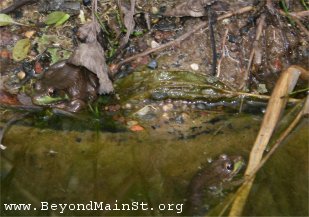 In other news, yes Virginia there are still frogs in my pond. You'd think that with the average temp dropping below 50 some days (and below 40 some nights,) they'd start burrowing in the mud around the banks, but I counted at least six Green Frogs sunning themselves in the shallows this morning. Hope they're not getting two comfy, as the project I have to take on next weekend is going to involve draining the plastic pond and smashing it into small enough pieces to cram into the trash bin.
Seems that when I added on the second pond basin and the stream to connect the two basins with rubber liner I forgot to take into account the fact that the sun heats the plastic basin to the point where it expands and contracts on a daily basis. Alone, and in a bed of sand, you'd never notice this, but try to couple it with a non-conductive rubber liner and no among of sealant, self-expanding foam, or bolts will keep a watertight seal.
Which means you're going to have leaks.
Which means adding more water via a hose on a timer on a daily basis. Which not only flies in the face of water conservation, but costs money, and forces the filters and the fish to cope with a daily influx of the brown rust crap from our water table. While I'm not exactly giddy about the prospect of rebuilding the first basin, it will give me an opportunity to excavate a deeper stream for my goldfish. If they continue growing at this rate, they'll certainly need it.
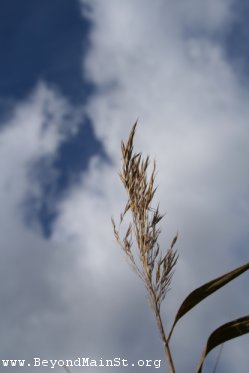
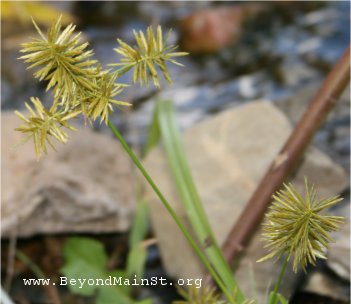 Seems to have been a good year for native gardening; the Harebell's still blooming, the Pasqueflower is thick, and the stand of Swamp Milkweed flourishing by the driveway is almost as tall as I am. We've also got a transplant from Long Lake in Stillwater (I've included it to the left), some sort of rush-type plant with grass-like leaves and five balls of green spikes on each stalk.
Anyways, we're planning on a quiet evening and maybe a little archery practice here.
Monday, September 18, 2006

In the insane rush to get this year's chunk of pond garden finished before the snow flies, we've started building a raised patio up above the waterfall. It's not a huge in area only about 8'X7', but that didn't mean it hasn't been a process.
So far, the area's been weeded, excavated, the pipes and cords run through aluminum pipes, the dirt screeded and packed down with a makeshift tamper, the screeder (a 2X6 mounted to a 2X4) raised to allow for 1" of sand. The sand (we needed about 20 bags for the area) was dumped in bag by bag, screeded, packed, and screeded again. Each rainfall (we've gotten three since Saturday; a bad one Saturday night that wreaked hell in Rogers), required an additional packing and screeding.
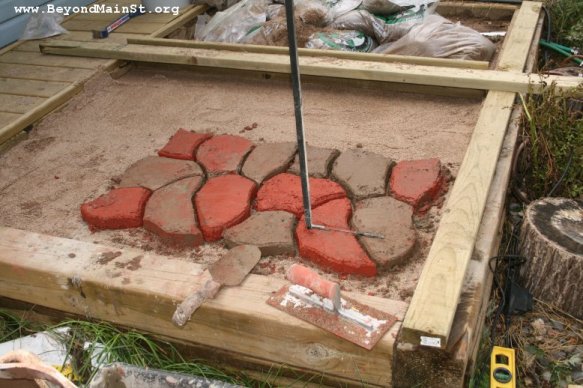
The cement had to be mixed in two basins; one for red (with ash for texture) and one for gray (with sand for texture), and was then poured into a random stone mold, which I picked up at Menards. The section you see was about a bag and a half. The black feeder pole you see was shoved in while the bricks were semi-hard.
Saw massive flocks of American Goldfinch over the weekend. Both feeders were filled with the smallish yellow birds at some points, with others queuing up on the pole or in the branched of the potted palm. I'd assume this indicates a good deal of them banding together to head South, and that soon enough we'll only be seeing the smallish bands of year-round resident finches making their rounds of the feeders.
Area wildlife spotted the last week:
- Red-shouldered hawk
- American goldfinch
- Monarch butterfly
- Red-bellied woodpecker
- Hairy woodpecker
- Black-capped Chickadee
- Nuthatch
- Gray Squirrel
- Eastern Chipmunk
Flowers Blooming in Pond Garden:
- Showy Goldenrod
- Daisy Fleabane
- Harebell

